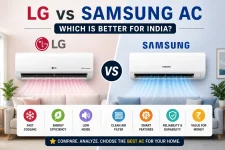
LG and Samsung are the two most popular AC brands in India — and every summer, millions of buyers ask the same question: which one should I buy? Both brands make excellent inverter split ACs. Both use 100% copper coils, work in Indian heat, and have smart features. But they are genuinely different in the things that matter most for Indian homes.
LG prioritises energy efficiency, quiet operation, and service network. Samsung prioritises smart features, rapid cooling, WindFree silence, and warranty coverage. The wrong choice based on brand loyalty alone can mean 10 years of high bills, poor cooling, or no technician when your AC breaks down in 47°C heat.
We compared both brands head-to-head across 8 critical factors — using real 2026 ISEER values, warranty terms, noise data, and after-sales service quality — to give you an honest, numbers-based answer.
📋 Key Comparison Facts — 2026
Samsung: 5.15 ISEER
Samsung WindFree: 24 dB
Samsung: 5 Years
Samsung: 58°C
Samsung: Metro cities only
Samsung: 20 Years
- Best service network — Tier 1, 2 and 3 cities
- Highest ISEER 5.20 — marginally better efficiency
- 31 dB — very quiet operation
- 6-in-1 AI Convertible — ThinQ WiFi
- Gold Fin + Ocean Black coil protection
- Better value per rupee at comparable prices
- WindFree mode — 24 dB, India’s quietest AC
- 5-year comprehensive + 20-year compressor warranty
- 58°C ambient — best for extreme heat zones
- SmartThings, Alexa, Google, Bixby — full smart home
- Durafin Blue + Triple Protector Plus
- AI Energy Mode learns usage patterns
🎯 Who Should Buy Which — At a Glance
🔴 Buy LG if you…
- 🏘️ Live in a Tier 2 or Tier 3 city
- 🔧 Want India’s best after-sales service
- ⚡ Prioritise maximum energy efficiency
- 💰 Have a budget under ₹45,000
- 🌊 Live in a coastal city — Gold Fin protection
- 📱 Don’t need advanced smart features
- 🛌 Want reliable, quiet daily bedroom cooling
🔵 Buy Samsung if you…
- 🏙️ Live in Delhi, Mumbai, Bengaluru, Chennai
- 😴 Want the quietest AC — 24 dB WindFree
- 📲 Use Alexa, Google Home, or SmartThings
- 🛡️ Want 5-year comprehensive warranty
- 🌡️ Live in extreme heat — Rajasthan, Gujarat, Telangana
- 💎 Have budget above ₹50,000
- 🔆 Want the latest AI and smart features
LG and Samsung are the two most popular AC brands in India — and choosing between them is one of the most common questions Indian buyers ask every summer. Both brands make excellent air conditioners. Both use inverter technology, 100% copper coils, and are designed for Indian weather conditions. But they are genuinely different in the things that matter most.
LG prioritises energy efficiency, service network, and quiet operation. Samsung prioritises smart features, faster cooling, and a longer comprehensive warranty. Knowing which matters more for your situation is the entire decision.
We compared both brands across 8 critical factors — using real 2026 specification data, ISEER values, warranty terms, and after-sales service quality — to give you an honest, numbers-based answer.
Best at: Energy efficiency, quiet operation, air quality, and service network in Tier 2 and 3 cities.
LG’s Dual Inverter Compressor has a slightly higher ISEER (5.20 vs 5.15) and operates at just 31 dB — among the quietest inverter ACs in India. The 10-year compressor warranty and widest service network make LG the lower-risk long-term choice.
Best at: Smart features, rapid cooling, silent WindFree mode, and the longest comprehensive warranty (5 years).
Samsung’s WindFree AI operates at just 24 dB in WindFree mode — the quietest AC in India. It cools at up to 58°C outdoor temperature (vs LG’s 55°C), has a 20-year compressor warranty, and integrates seamlessly with Alexa and Google Home.
Round-by-Round Comparison — 8 Factors That Matter
Based on real 2026 specifications and verified performance data
⚡ Round 1 — Energy Efficiency
🔴 LG Dual Inverter
ISEER: 5.20. Annual consumption: 744 units (1.5T 5-star). LG’s Dual Inverter compressor runs at variable speeds with greater precision, achieving marginally better efficiency. Rated 10-year compressor warranty covers the efficiency engine long-term.
🔵 Samsung WindFree AI
ISEER: 5.15. Annual consumption: 751 units (1.5T 5-star). Samsung’s AI Energy Mode learns usage patterns and adjusts cooling cycles. The difference in real-world usage is marginal — approximately ₹50–80 per year at ₹8/unit.
❄️ Round 2 — Cooling Performance
🔴 LG Dual Inverter
Cooling capacity: 5800W. Max ambient: 55°C. Air circulation: 18.49 m³/min. LG’s cooling is more consistent — maintains steady temperature with minimal fluctuation (±1.4°C variation across a room). Suitable for most Indian cities.
🔵 Samsung WindFree AI
Cooling capacity: 6000W. Max ambient: 58°C. Temperature uniformity: ±0.8°C variation. Samsung’s WindFree micro-hole diffusion creates more even room temperature. Higher cooling capacity handles extreme conditions better. Rated to 58°C — the highest in this comparison.
🔇 Round 3 — Noise Level
🔴 LG Dual Inverter
Indoor noise: 31 dB at lowest speed. This is very quiet — equivalent to a whisper in a library. LG is consistently among the quietest AC brands in India. Excellent for bedrooms and study rooms.
🔵 Samsung WindFree AI
Indoor noise: 24 dB in WindFree mode — the quietest AC in this segment. WindFree mode disperses air through 23,000 micro-holes instead of direct airflow — eliminating the “cold draught” feeling and almost all fan noise. Comparable to complete silence.
📱 Round 4 — Smart Features
🔴 LG Dual Inverter
WiFi via LG ThinQ app. 6-in-1 AI Convertible modes. Remote monitoring and scheduling. Voice control via Alexa and Google Home. Auto-diagnosis function. LG’s smart features are comprehensive but less advanced than Samsung’s AI system.
🔵 Samsung WindFree AI
WiFi via SmartThings app. AI Energy Mode learns usage patterns. WindFree technology — no direct cold draught. Voice control — Alexa, Google, and Bixby. Good Sleep mode syncs with Samsung Galaxy Watch for personalised sleep cooling. Advanced smart home integration.
🛡️ Round 5 — Warranty Coverage
🔴 LG Dual Inverter
Product warranty: 1 year comprehensive. PCB warranty: 5 years. Compressor warranty: 10 years. Total protection is good but the 1-year comprehensive warranty means any non-compressor repair in year 2–5 is paid by you.
🔵 Samsung WindFree AI
Product warranty: 5 years comprehensive. Compressor warranty: 20 years. Samsung’s 5-year comprehensive warranty covers all parts and labour for 5 years — 4 years more than LG. The 20-year compressor warranty is the longest available in India in 2026.
🏙️ Round 6 — After-Sales Service Network
🔴 LG Dual Inverter
LG has India’s largest AC service network — covering Tier 1, Tier 2, and Tier 3 cities comprehensively. Technicians available in most towns with populations above 50,000. Average service response time: 24–48 hours across India. Spare parts widely available.
🔵 Samsung
Samsung has excellent service in metro cities — Mumbai, Delhi, Bengaluru, Chennai, Hyderabad. However, service quality becomes inconsistent in Tier 2 and 3 cities. Average service response time varies: 24 hours in metros, 3–5 days in smaller cities. Fewer service centres in towns below 200,000 population.
🔧 Round 7 — Build Quality & Coil Protection
🔴 LG Dual Inverter
100% copper condenser coil. Ocean Black Protection coating for indoor unit — hydrophilic, anti-corrosion. Gold Fin coating for outdoor condenser — anti-rust, especially useful in coastal and humid areas. Anti-bacterial, anti-fungal filters. Excellent build quality on both units.
🔵 Samsung WindFree AI
100% copper condenser coil. Durafin Blue coating for outdoor coil — hydrophilic, anti-corrosion, UV resistant. Triple Protector Plus — safeguards against voltage fluctuations, overloading, and gas leakage. Freeze Wash technology cleans the indoor unit automatically. Strong build quality throughout.
💰 Round 8 — Price and Value for Money
🔴 LG Dual Inverter
LG 1.5T 5-star inverter AC: ~₹42,000–48,000. Excellent features-per-rupee ratio. Better service coverage means fewer hidden costs from service delays. Wide range of models from ₹28,000 (1T 3-star) to ₹55,000+ (1.5T 5-star with ThinQ WiFi).
🔵 Samsung WindFree AI
Samsung WindFree AI 1.5T 5-star: ~₹52,000–58,000. Premium pricing for premium features. The 5-year comprehensive warranty partly justifies the extra cost. For buyers wanting just cooling without smart features, Samsung’s basic models are comparably priced to LG.
Final Scorecard
LG vs Samsung — 8 rounds, honest verdict
| Factor | LG Dual Inverter | Samsung WindFree AI | Winner |
|---|---|---|---|
| Energy Efficiency (ISEER) | 5.20 ISEER — 744 units/yr | 5.15 ISEER — 751 units/yr | 🔴 LG |
| Cooling Performance | 5800W, 55°C ambient | 6000W, 58°C ambient, ±0.8°C uniformity | 🔵 Samsung |
| Noise Level | 31 dB indoor | 24 dB WindFree mode | 🔵 Samsung |
| Smart Features | ThinQ WiFi, 6-in-1 AI | SmartThings, WindFree, AI learning, Galaxy Watch | 🔵 Samsung |
| Warranty | 1 yr comprehensive, 10 yr compressor | 5 yr comprehensive, 20 yr compressor | 🔵 Samsung |
| Service Network | Best in India — all Tier 1/2/3 cities | Excellent metros, inconsistent Tier 2/3 | 🔴 LG |
| Build & Coil Protection | Ocean Black + Gold Fin coating | Durafin Blue + Triple Protector Plus | 🟣 Tie |
| Value for Money | Better features/rupee ratio | Premium pricing for premium features | 🔴 LG |
Samsung wins on pure feature count — but LG’s service network win is the most impactful factor for most Indian buyers outside metro cities.
Head-to-Head — Best 2026 Models Compared
1.5 Ton 5-Star — the most popular AC segment in India
LG 1.5 Ton 5 Star Dual Inverter
Model: US-Q19PWZE / AS-Q18SXZA (2026)
Samsung 1.5 Ton 5 Star WindFree AI
Model: AR60F19D1ZWNNA (2026)
🏆 Final Verdict — Who Should Buy Which?
🔴 Choose LG if you…
- Live in a Tier 2 or Tier 3 city
- Want the best service network in India
- Prioritise energy efficiency above all
- Have a budget under ₹45,000
- Do not need advanced smart features
- Are in a coastal area needing Gold Fin protection
- Want reliable, no-fuss daily operation
🔵 Choose Samsung if you…
- Live in a metro city (Delhi, Mumbai, Bengaluru)
- Want the quietest AC available — 24 dB WindFree
- Use smart home ecosystem (Alexa/Google/Bixby)
- Want 5-year comprehensive warranty peace of mind
- Live in extreme heat areas — 58°C ambient rating
- Want 20-year compressor warranty
- Have budget above ₹50,000
Recommended Post: AC Buying Guide for Indian Homes: 10 Things to Check Before Buying
Conclusion
After comparing both brands across 8 critical factors with real 2026 data, the honest answer is this: neither brand is universally better. They are better in different situations. Choosing the wrong one for your situation means either paying for features you never use or struggling with poor service for 10 years.
Samsung is the better AC on paper. It wins on cooling performance, noise level, smart features, and warranty. The 5-year comprehensive warranty, 24 dB WindFree silence, 58°C ambient rating, and 20-year compressor warranty are genuinely industry-leading specifications. If you are buying an AC for a metro city apartment and will actively use the smart features, Samsung is the better product.
LG is the safer AC for most Indian buyers. The service network advantage is not a minor detail — it is the most important practical factor for the 70% of Indians who live outside the top 5 metro cities. An AC that cannot be serviced within 48 hours during a 47°C May afternoon in Lucknow, Nagpur, or Coimbatore is not a premium purchase — it is a liability. LG’s energy efficiency lead, while small, is real. And at comparable price points, LG consistently offers better features-per-rupee.
The ₹50–80 annual electricity difference between LG and Samsung is completely irrelevant — do not make a decision based on this.
The service network difference is very relevant — if you live outside Delhi, Mumbai, Bengaluru, Chennai, or Hyderabad, LG is the lower-risk choice. Full stop.
If you can afford Samsung’s premium and you live in a metro, buy the WindFree AI. It is genuinely the best AC available in India right now on pure specifications. The WindFree silence at 24 dB is something you will appreciate every single night for the next 10 years.
If you want reliability, value, and the peace of mind of India’s best service network — buy LG. It has earned its position as India’s most trusted AC brand for good reason.
Frequently Asked Questions
Common questions about LG vs Samsung AC for Indian homes
Last updated: April 2026. Specifications based on 2026 model data from LG and Samsung India. ISEER values from BEE energy label data. Prices approximate and subject to change on Amazon India.
IndianShops.in participates in the Amazon Associates Program. We earn a small commission when you purchase through our links — at no extra cost to you.