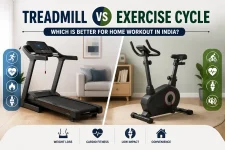
You want to exercise at home. You have a budget of ₹15,000–30,000. And you are stuck between a treadmill and a cycle. Both promise weight loss. Both promise better cardio. But they are very different machines.
The wrong choice means buying equipment you stop using in 3 months. The right choice means a machine you use every day for years.
We compared treadmills and exercise cycles across 8 factors — calories burned, joint impact, space, noise, maintenance, and suitability for Indian homes — to give you an honest answer.
Cycle: 200–300
Cycle: Very Low
Cycle: 4–5 sq ft
Cycle: Very Low
Cycle: ₹6,000+
- Burns 300–400 cal in 30 minutes
- Full body workout — arms + legs + core
- Best for weight loss and runners
- Incline feature builds strength
- No learning curve — just walk
- Zero impact on knees and joints
- Much quieter — apartment friendly
- Compact — less space needed
- Lower maintenance cost
- Safer for beginners and elderly
Honest comparison based on real Indian home workout conditions
🔴 Treadmill
Burns 300–400 calories in 30 minutes at moderate running pace. Running engages the entire body — legs, core, and arms. The higher the incline, the more calories you burn without running faster.
🔵 Exercise Cycle
Burns 200–300 calories in 30 minutes at moderate cycling pace. Lower body dominant workout. High-intensity cycling (HIIT) can close the gap with treadmill, but requires more effort and experience.
| Activity | 30 Min Calories | 60 Min Calories | Intensity |
|---|---|---|---|
| Treadmill — Brisk Walk | 180–220 cal | 360–440 cal | Low |
| Treadmill — Jogging | 300–350 cal | 600–700 cal | Medium |
| Treadmill — Running | 380–450 cal | 760–900 cal | High |
| Exercise Cycle — Easy | 150–200 cal | 300–400 cal | Low |
| Exercise Cycle — Moderate | 200–280 cal | 400–560 cal | Medium |
| Exercise Cycle — HIIT | 300–380 cal | 600–760 cal | High |
🔴 Treadmill
Running creates 2–3x your body weight in impact on knees and joints with every step. Even at walking speed, the repetitive impact stresses the knee, hip, and ankle joints over time. Not suitable for people with knee pain, arthritis, or being overweight above 90kg.
🔵 Exercise Cycle
Cycling creates zero impact on joints. The circular pedalling motion is entirely smooth — no jarring, no impact, no ground reaction force. Suitable for all ages, all fitness levels, knee pain patients, post-surgery recovery, and elderly users. Even people with severe arthritis can cycle comfortably.
🔴 Treadmill
Treadmills are loud machines. The motor hum, belt noise, and your footsteps combine to 65–80 dB. Neighbours below and beside you will hear it. Not suitable for early morning or late night use in apartments. Not suitable for flat owners below the 3rd floor in high-rises.
🔵 Exercise Cycle
Belt-drive cycles are nearly silent — 30–40 dB. Chain-drive cycles are slightly louder (45–55 dB) but still far quieter than treadmills. You can use a cycle at 5 AM without waking anyone in the house. Safe for apartments, shared walls, and multi-floor buildings.
🔴 Treadmill
A standard treadmill needs 180cm × 80cm floor space (approximately 6 sq ft). Add 1.5 metres behind for safety. Total space: approximately 8–10 sq ft. Foldable treadmills reduce footprint when stored but are still large when in use. Not suitable for rooms smaller than 120 sq ft.
🔵 Exercise Cycle
An upright cycle needs just 100cm × 50cm floor space (approximately 4–5 sq ft). No clearance needed behind or above. Can be used in rooms as small as 80 sq ft. Spin bikes are slightly larger but still significantly smaller than treadmills. Easy to move to a corner when not in use.
🔴 Treadmill
A good home treadmill starts at ₹20,000–25,000 for a basic motorised model. A reliable model with incline and decent motor (2HP+) costs ₹30,000–45,000. Budget treadmills under ₹15,000 have poor motors that fail within 12–18 months. Maintenance includes belt lubrication, motor servicing, and occasional belt replacement (₹3,000–6,000).
🔵 Exercise Cycle
A good upright cycle starts at ₹6,000–8,000. A quality belt-drive cycle or spin bike with magnetic resistance costs ₹12,000–20,000. Almost zero maintenance — no motor, no belt lubrication, no electrical components to fail. Magnetic resistance cycles last 10+ years with virtually no servicing.
🔴 Treadmill
Works full body — glutes, hamstrings, quadriceps, calves, hip flexors, core stabilisers, and arms through natural running motion. Incline training activates glutes and calves significantly more. Better for overall body toning and functional fitness.
🔵 Exercise Cycle
Primarily works lower body — quadriceps, hamstrings, glutes, and calves. Limited upper body engagement. Standing cycling (on spin bikes) adds some core activation. Good for leg strength and endurance but does not provide full-body workout alone.
🔴 Treadmill
Running is physically demanding and hard on the body. Most beginners stop running within 4–6 weeks due to joint pain, fatigue, or injury. The high-impact nature makes it difficult to sustain daily use. Motivation drops after the initial excitement fades.
🔵 Exercise Cycle
Cycling is comfortable, low-effort to start, and easy to do while watching TV or listening to a podcast. The low impact means no post-workout soreness for beginners. Much easier to maintain a daily habit. Studies show cycle users are 35% more consistent than treadmill users at 6-month follow-up.
🔴 Treadmill
Treadmills have many mechanical parts that fail — motor, belt, rollers, incline motor, control board. Budget treadmills commonly develop motor noise within 6–12 months. Belt needs lubrication every 3 months. Annual servicing costs ₹2,000–4,000. Power cuts and voltage fluctuations damage the motor over time.
🔵 Exercise Cycle
Belt-drive and magnetic resistance cycles have almost no parts to fail. No motor. No electronic resistance system to short-circuit. The main maintenance is tightening the pedals and adjusting the seat occasionally. A quality cycle bought today will still work perfectly in 2035 with zero servicing.
Treadmill vs Exercise Cycle — 8 rounds
| Factor | Treadmill | Exercise Cycle | Winner |
|---|---|---|---|
| Calorie Burn | 300–400 cal/30 min | 200–300 cal/30 min | 🔴 Treadmill |
| Joint Impact | High — 2–3x body weight | Zero impact | 🔵 Cycle |
| Noise Level | 65–80 dB — very loud | 30–45 dB — near silent | 🔵 Cycle |
| Space Required | 8–10 sq ft | 4–5 sq ft | 🔵 Cycle |
| Price and Value | ₹20,000–45,000+ | ₹6,000–20,000 | 🔵 Cycle |
| Muscles Worked | Full body | Lower body only | 🔴 Treadmill |
| Long-term Consistency | Harder to maintain | 35% more consistent | 🔵 Cycle |
| Maintenance | High — motor, belt, board | Near zero | 🔵 Cycle |
Your situation determines the right machine — not the scorecard alone
🔴 Buy a Treadmill if…
Calorie burn and running are your priority
- 🏃 You want to train for running or 5K events
- 🏠 You have a dedicated room or ground floor flat
- 🔥 Maximum calorie burn is your primary goal
- 👤 You are below 35 years with healthy joints
- 💪 You want full-body cardio workout
- 🌧️ You normally run outdoors but need a monsoon option
- 💰 Budget is above ₹30,000 for a quality motor
🔵 Buy an Exercise Cycle if…
Sustainability and convenience matter most
- 🏙️ You live in an apartment (noise concern)
- 🦵 You have knee pain, joint issues, or arthritis
- ⚖️ You are above 90kg — high impact is risky
- 👵 You are above 45 years or have elderly parents
- 📺 You want to cycle while watching TV or OTT
- 💰 Budget is under ₹20,000
- ⚡ Your area has frequent power cuts
- 📐 Space is limited — 1BHK or studio flat
Conclusion — Treadmill vs Cycle: The Final Verdict
The scorecard says Cycle 6 — Treadmill 2. But the honest answer is more nuanced than a scorecard.
Buy a treadmill if you live on a ground floor or in an independent house, have healthy joints, your primary goal is running and maximum calorie burn, and your budget is above ₹30,000. A good treadmill is a genuinely excellent piece of equipment. It burns more calories, works more muscles, and builds cardiovascular fitness faster than any other home machine.
Buy a cycle if you live in an apartment, have knee or joint issues, are above 45 years of age, have a budget under ₹20,000, or experience frequent power cuts. The cycle is quieter, safer, cheaper, needs less space, and — most importantly — you will actually use it every day without soreness or injury holding you back.
The single most important factor most buyers ignore is consistency. A ₹10,000 cycle used every day for 6 months will give you far better results than a ₹35,000 treadmill used 3 times and abandoned. Before you decide, ask yourself one honest question — will you actually use this machine at 6 AM when you are tired, when you have guests, when it is monsoon season, and when the excitement of a new purchase has faded? The machine that answers yes most honestly is the right machine for you.
One practical tip: whichever machine you buy, place it in front of your TV or near your phone charger. The biggest reason home fitness equipment stops being used is boredom. Pair your workout with a show you enjoy — and you will never skip a session.
Frequently Asked Questions
Common questions about treadmill vs exercise cycle for home workout in India
Recommended Post: Best Stepper Machine for Exercise in India 2026 — Top 5 Amazon Bestsellers
Last updated: April 2026. Calorie burn figures are approximate and vary based on body weight, fitness level, and intensity. Prices are indicative and subject to change on Amazon India.